Over 4 chapters, we completed the most central part of the GPT model: the self-attention mechanism.
Next, we will focus on the engineering implementation of GPT pre-training.
A distinctive feature of GPT models is that “scale works wonders” (a Chinese saying, literally “great force produces miracles”). It shows not only in the massive data used for training, but also in the huge parameter count and in deep network structures of dozens or even hundreds of layers. Specifically, the GPT-3 model has 96 Transformer blocks, and deeper models have more layers. The more Transformer blocks are stacked, the harder training gets. During backpropagation the gradient has to pass through dozens or hundreds of layers, and each layer “dilutes” it a little more, until it almost vanishes in the last few layers. This is the so-called vanishing gradient problem.
Residual connection
In 2015, Kaiming He and colleagues at Microsoft Research proposed the concept of the residual connection, which has greatly alleviated the challenges associated with training deep neural networks. This paper (ResNet) is one of the most cited papers in the history of deep learning.
The core idea of the residual connection is extremely simple: let the output of each layer = input + transformation.
instead of the traditional .
Why does the residual connection work
Forward pass: even if is learned poorly, the output still contains at least, so no information is lost;
Backward pass: the gradient can flow back through and does not depend entirely on the gradient of , so the vanishing gradient problem is greatly eased.
A residual connection is like building an extra highway for the gradient: however winding the in between may be, the gradient can always flow back to the earlier layers unobstructed.
Where to add residual connections
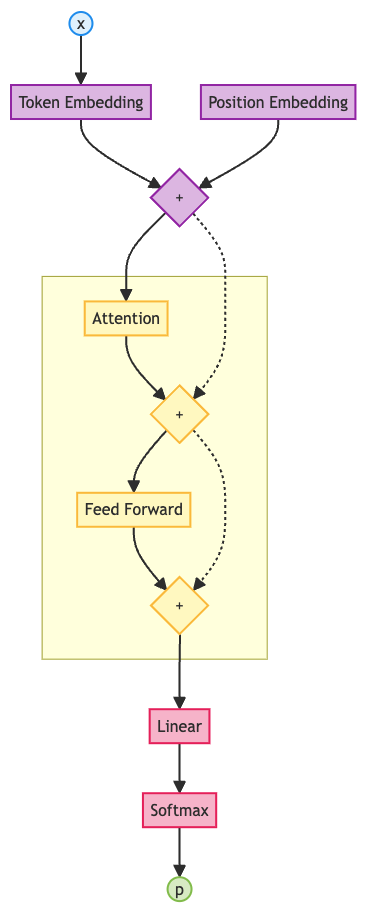
In the GPT model, the depth of the network consists mainly of Transformer blocks. A Transformer block contains two sublayers: self-attention and the feed-forward network. Each sublayer needs a residual connection:
self-attention: ;
feed-forward network: .
In this way, no matter how many Transformer blocks are stacked, the gradient can reach the first layer smoothly, avoiding vanishing gradients.
import numpy as np

from src.core import *np.random.seed(42)class CharDataset(Dataset):
def __init__(self, filename, batch_size=1, context_size=64, stride=None, split=0.9):
self.filename = filename
self.context_size = context_size
self.stride = stride if stride is not None else context_size // 2
self.split = split
super().__init__(batch_size)
def load(self):
with open(self.filename, encoding="utf-8") as f:
text = f.read()
self.vocab = sorted(set(text))
self.vocab_size = len(self.vocab)
self.stoi = {ch: i for i, ch in enumerate(self.vocab)}
self.itos = {i: ch for i, ch in enumerate(self.vocab)}
self.tokens = self.encode(text)
split = int(len(self.tokens) * self.split)
self.train_data = self._pack(self.tokens[:split])
self.test_data = self._pack(self.tokens[split:])
def _pack(self, tokens):
x, y = [], []
for i in range(0, len(tokens) - self.context_size - 1, self.stride):
x.append(tokens[i: i + self.context_size])
y.append(tokens[i + 1: i + self.context_size + 1])
return x, y
def encode(self, symbols):
return [self.stoi[s] for s in symbols]
def decode(self, tokens):
return "".join(self.itos[t] for t in tokens)Lower triangular matrix layer
class Tril(Layer):

    def __init__(self, value=-1e9):
        super().__init__()
        self.value = value

    def forward(self, x: Tensor):
        keep = np.tril(np.ones(x.shape[-2:]))
        p = Tensor(np.where(keep, x.data, self.value))

        def gradient_fn():
            x.grad += p.grad * keep

return p.attach(gradient_fn, {x})class GELU(Layer):
def __init__(self):
super().__init__()
self.c = np.sqrt(2.0 / np.pi)
def forward(self, x: Tensor):
tanh = np.tanh(self.c * (x.data + 0.044715 * x.data ** 3))
a = Tensor(0.5 * x.data * (1.0 + tanh))
def gradient_fn():
grad = 0.5 * (1.0 + tanh) + 0.5 * x.data * (1.0 - tanh ** 2) * self.c * (1.0 + 3.0 * 0.044715 * x.data ** 2)
x.grad += a.grad * grad
return a.attach(gradient_fn, parents=[x])class GPTLoss(Loss):
def loss(self, p: Tensor, y: Tensor):
exp = np.exp(p.data - np.max(p.data, axis=-1, keepdims=True))
softmax = exp / np.sum(exp, axis=-1, keepdims=True)
flat_softmax = softmax.reshape(-1, softmax.shape[-1])
flat_y = y.data.reshape(-1).astype(np.int64)
n = len(flat_y)
rows = np.arange(n)
log = np.log(np.clip(flat_softmax[rows, flat_y], 1e-10, 1))
ce = Tensor(0 - np.sum(log) / n)
def gradient_fn():
flat_grad = flat_softmax.copy()
flat_grad[rows, flat_y] -= 1
p.grad += ce.grad * flat_grad.reshape(softmax.shape) / n
return ce.attach(gradient_fn, parents=[p])class GPTEmbedding(Composite):
def __init__(self, vocab_size, context_size, embedding_size):
self.embedding = Embedding(vocab_size, embedding_size)
self.positional_embedding = Embedding(context_size, embedding_size)
super().__init__([self.embedding,
self.positional_embedding])
def forward(self, x: Tensor):
token = self.embedding(x)
position = self.positional_embedding(Tensor(range(x.shape[1])))
return token + positionGPT attention layer
We add a residual connection at the end of the GPT attention layer, changing the output from self.output(...) to x + self.output(...).
class GPTAttention(Composite):

    def __init__(self, embedding_size, heads=1):
        self.embedding_size = embedding_size
        self.heads = heads

        self.query = Linear(embedding_size, embedding_size)
        self.key = Linear(embedding_size, embedding_size)
        self.value = Linear(embedding_size, embedding_size)
        self.mask = Tril()
        self.softmax = Softmax()
        self.output = Linear(embedding_size, embedding_size)

        super().__init__([self.query,
                          self.key,
                          self.value,
                          self.mask,
                          self.softmax,
                          self.output])

    def forward(self, x: Tensor):
        head_embedding_size = self.embedding_size // self.heads
        multi_head_shape = (-1, x.shape[1], self.heads, head_embedding_size)
        shape = (-1, x.shape[1], self.embedding_size)

        query = self.query(x).reshape(multi_head_shape).transpose((0, 2, 1, 3))
        key = self.key(x).reshape(multi_head_shape).transpose((0, 2, 3, 1))
        value = self.value(x).reshape(multi_head_shape).transpose((0, 2, 1, 3))
        scale = Tensor(np.array(1.0 / np.sqrt(head_embedding_size)))
        scores = query @ key * scale
        weights = self.softmax(self.mask(scores))
        # Residual connection
        return x + self.output((weights @ value).transpose((0, 2, 1, 3)).reshape(shape))
GPT feed-forward network layer
Likewise, we add a residual connection at the end of the GPT feed-forward network layer, changing the output from self.output(...) to x + self.output(...).
class GPTFeedForward(Composite):

    def __init__(self, embedding_size):
        self.input = Linear(embedding_size, embedding_size * 4)
        self.gelu = GELU()
        self.output = Linear(embedding_size * 4, embedding_size)

        super().__init__([self.input,
                          self.gelu,
                          self.output])

    def forward(self, x: Tensor):
        h = self.gelu(self.input(x))
        # Residual connection
        return x + self.output(h)
GPT Transformer block
class GPTTransformer(Composite):

    def __init__(self, embedding_size, heads):
        self.attention = GPTAttention(embedding_size, heads)
        self.feed_forward = GPTFeedForward(embedding_size)

        super().__init__([self.attention,
                          self.feed_forward])

    def forward(self, x: Tensor):
        x = self.attention(x)
        return self.feed_forward(x)
GPT output layer
class GPTOutput(Composite):

    def __init__(self, embedding_size, vocab_size):
        self.output = Linear(embedding_size, vocab_size)

        super().__init__([self.output])

    def forward(self, x: Tensor):
        return self.output(x)
GPT model
class GPT(Composite):

    def __init__(self, vocab_size, context_size, embedding_size, heads, blocks):
        self.embedding = GPTEmbedding(vocab_size, context_size, embedding_size)
        self.transformers = [GPTTransformer(embedding_size, heads) for _ in range(blocks)]
        self.output = GPTOutput(embedding_size, vocab_size)

        super().__init__([self.embedding] + self.transformers + [self.output])

    def forward(self, x: Tensor):
        x = self.embedding(x)
        for layer in self.transformers:
            x = layer(x)
        return self.output(x)
GPT trainer
class GPTTrainer(Trainer):

    def train(self, dataset, epochs, scheduler=None):
        dataset.train()
        self.model.train()

        steps = 0
        for epoch in range(epochs):
            for i in range(len(dataset)):
                if scheduler is not None:
                    self.optimizer.lr = scheduler.step(steps)

                feature, label = dataset[i]

                self.optimizer.zero_grad()
                prediction = self.model(feature)
                loss = self.loss_fn(prediction, label)
                loss.backward()
                self.optimizer.clip_grad_norm()
                self.optimizer.step()
                steps += 1

    def test(self, dataset):
        dataset.eval()
        self.model.eval()

        predictions = []
        total_loss = 0.0
        with Tensor.no_grad():
            for i in range(len(dataset)):
                feature, label = dataset[i]
                prediction = self.model(feature)
                loss = self.loss_fn(prediction, label)
                predictions.append(prediction)
                total_loss += float(loss.data)

        loss = total_loss / len(dataset)
        dataset.train()
        self.model.train()
        return predictions, loss

    def generate(self, dataset, prompt, steps=256):
        self.model.eval()
        tokens = dataset.encode(prompt)

        with Tensor.no_grad():
            for _ in range(steps):
                feature = Tensor([tokens[-dataset.context_size:]])
                logits = self.model(feature)

                last_logits = logits.data[0, -1]
                exp = np.exp(last_logits - np.max(last_logits))
                probs = exp / np.sum(exp)
                token = np.random.choice(len(probs), p=probs)
                tokens.append(token)

return dataset.decode(tokens)LEARNING_RATE = 0.001Batch size
BATCH_SIZE = 4Number of epochs
EPOCHS = 2Context size
CONTEXT_SIZE = 32Embedding size
EMBEDDING_SIZE = 64Number of heads
HEADS = 2Number of Transformer blocks
BLOCKS = 2Modeling
DATA_FILE = "../../../../data/tinyshakespeare.txt"

dataset = CharDataset(DATA_FILE, BATCH_SIZE, CONTEXT_SIZE)
model = GPT(dataset.vocab_size, CONTEXT_SIZE, EMBEDDING_SIZE, HEADS, BLOCKS)
loss_fn = GPTLoss()
optimizer = AdamWOptimizer(model.parameters, lr=LEARNING_RATE)
trainer = GPTTrainer(model, loss_fn, optimizer)Training
scheduler = WarmupCosineScheduler(LEARNING_RATE, EPOCHS * len(dataset), 100, LEARNING_RATE / 10)
trainer.train(dataset, EPOCHS, scheduler)Evaluation
prediction, loss = trainer.test(dataset)
print(f'prediction:\t{len(prediction)} steps, each {prediction[0].data.shape}\nloss:\t{loss}')
prediction: 1742 steps, each (4, 32, 65)
loss: 1.8085668785700706
Inference
print(trainer.generate(dataset, prompt="ROMEO:"))ROMEO:
Well, I'll poisen, swearn thee, haprite,
Will me is is fatherior offenretcher rangershed is in tet Catie, there name the king,
Lets Comiou, who no: well I delieve what bow,
And
Berancionr her; and love stime and in him esceasured,
That try love.
SIY:
HtU
In this chapter, we added residual connections to both sublayers of the Transformer block. The gradient now has a direct channel, and one of the training difficulties of deep neural networks, the vanishing gradient, is solved with ease.
But the residual connection also has a side effect: the output of every layer is “input + transformation”, so as the number of layers grows, the values keep accumulating and getting larger, which makes training unstable. In the next chapter, we will set out to solve this problem.
Exercises
Both sublayers of the Transformer block now have residual connections. Try removing one of them and see how the training results change.